
DESTINATIONS · HIDDEN ITALY
Find the Italy between the icons
Hill towns, mountain villages, small coastal communities and regional places worth slowing down for.
How to plan a small-town trip
Italy’s small towns are spread across every region. Pick a region first, then one base you can explore from on foot or by car. The hubs below group hill towns, villages and countryside stays, with how to get there, how long to stay and what to book.
The short answer: pick one region and one small-town base. Tuscany and Umbria are the classic hill-town regions, Abruzzo is wilder and quieter, Puglia pairs white towns with the sea, and Tuscia and Ciociaria are the closest to Rome. A car or a guided day trip makes most villages easier, and spring and fall are the most comfortable seasons.
Choosing among hidden villages in Italy comes down to three things: how far you want to be from a big city, whether you will drive, and what you want around you, from vineyards to sea cliffs. The shortlist, table and planning notes below help you decide.
Updated September 2026.
Regions and areas for small towns
Region hub
Tuscany
Hill towns, the Chianti wine roads and the Val d’Orcia, with Florence as the easy gateway.
Region hub
Umbria
Assisi, Perugia, Montefalco and a slower, greener version of central Italy.
Region hub
Abruzzo
Stone villages, national parks and the Trabocchi Coast, still off most itineraries.
Hidden gems guides
Longer reads on quieter places, by region and by season.
Guide · Abruzzo
Hidden gems of Abruzzo
Stone villages, castles and mountain landscapes most visitors never reach.
Guide · Italy
Alternatives to overtourism
Quieter places to swap in for Italy’s busiest sights.
Guide · Fall
Hidden villages for a fall trip
Smaller places across several regions, chosen for a fall visit.
Guide · Molise
Molise travel guide
Italy’s least-visited region: inland villages and a strong local identity.
Hidden villages in Italy, region by region
Not every small town on this list is a secret. Some, like San Gimignano or Alberobello, are famous. Still, most hidden villages in Italy sit a short drive from a well-known name, so the shortlist below pairs the icons with quieter neighbors. Each line points to the page that covers the place best.
Tuscia and Lazio: hidden villages in Italy closest to Rome
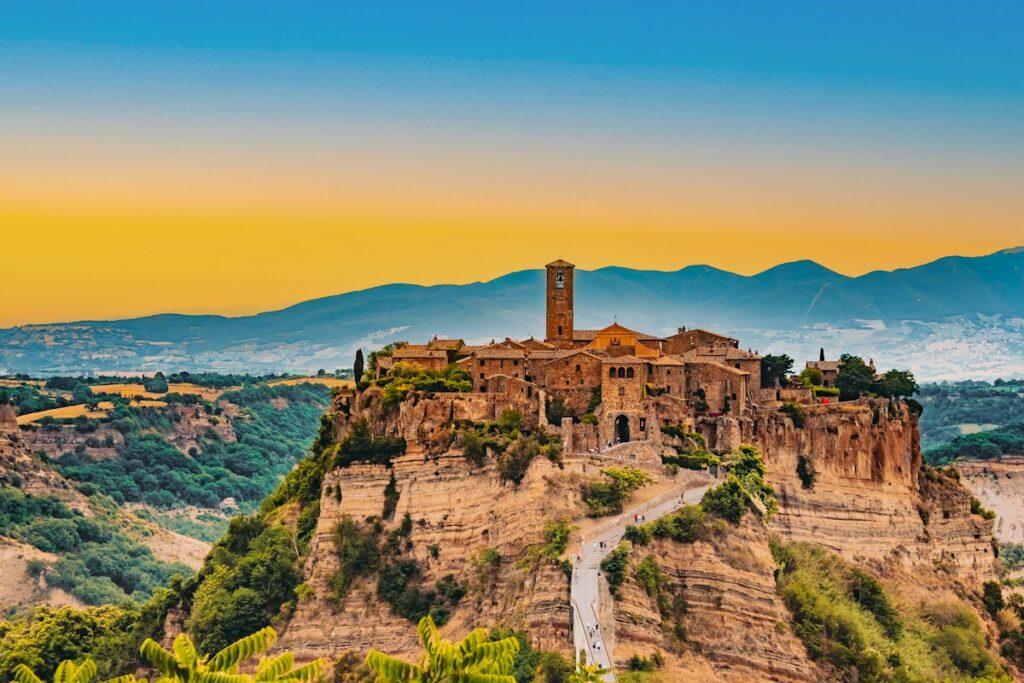
- Civita di Bagnoregio: a village on a crumbling tuff spur, reached on foot by a long bridge. Start with our guide to visiting Tuscia.
- Orvieto: a cathedral town on a volcanic cliff, just over the Umbrian border and an easy Orvieto day trip from Rome.
- Tivoli: a hill town east of the capital with two famous villas, one Renaissance and one Roman.
- Castelli Romani: a ring of old hill borghi, or historic villages, in the volcanic hills south of Rome, known for wine and papal summer residences.
- Ciociaria: hill towns, abbeys and mountain food between Rome and Naples. It is one of the least visited corners of Lazio, which makes its villages some of the most hidden villages in Italy within reach of the capital.
Tuscany: hill towns and wine villages
- San Gimignano: the medieval town of towers, a UNESCO site since 1990 (checked September 2026). It pairs well with Siena on a Siena, San Gimignano and Pisa day trip.
- Montalcino and Pienza: Brunello country in the Val d’Orcia. See Montalcino wine tours for how to visit.
- Montepulciano: a long hilltop street of cellars and Renaissance palaces, a short drive east of Pienza.
- Lucca: a walled town you can circle by bike on its ramparts. Read things to do in Lucca.
Umbria: the green heart
Assisi, Spello and Montefalco sit close together on the hills above the Umbrian valley. Assisi is a UNESCO site with its Franciscan landmarks (checked September 2026). Montefalco is known for Sagrantino wine, while Perugia makes a practical base with a train station.
Abruzzo and Molise: the wild side
Stone villages in the Apennines, such as Santo Stefano di Sessanio and Scanno, feel far from the tour-bus circuit. Our best places to visit in Abruzzo guide ranks them. Next door, Molise is even quieter, with hill towns and very few foreign visitors. For travelers who want truly hidden villages in Italy, these two regions are the strongest answer.
Puglia and Basilicata: white towns and cave cities
- Alberobello: the town of trulli, the round stone houses with conical roofs, a UNESCO site since 1996 (checked September 2026).
- Locorotondo and Ostuni: whitewashed old towns in and around the Itria Valley, an easy loop by car from Alberobello.
- Polignano a Mare: a cliff-top village above a small cove, best seen from the water.
- Matera: the Sassi, or cave districts, carved into a ravine in Basilicata. Our Matera guide explains how to visit.
The south and the islands
Off Naples, Procida is the small, colorful island that many visitors skip for Capri, and Ischia is its larger, greener neighbor. In Calabria, Tropea sits on a sandstone cliff over the sea. In Sicily, Castelmola perches above Taormina; see things to do in Taormina. On the Amalfi Coast, smaller villages like Atrani and Praiano are reachable by bus or boat, as explained in Amalfi Coast ferries.
The north: coast, vineyards and mountains
- Cinque Terre: five villages linked by trails and trains. Plan the walks with Cinque Terre hiking.
- Portofino and the Riviera: harbor villages east of Genoa, with Camogli as a quieter, more local alternative.
- Langhe villages: Barolo, La Morra and Barbaresco, part of a UNESCO vineyard landscape since 2014 (checked September 2026). See Barolo wine tours.
- Prosecco hills: Valdobbiadene and the steep vineyards around it, north of Venice. Read Prosecco hills tours.
- Dolomite villages: alpine towns under peaks that have been a UNESCO natural site since 2009 (checked September 2026). Many of the most scenic hidden villages in Italy are here, in side valleys away from the ski resorts.
Hidden villages in Italy: compare the regions
Use this table to match a region to your travel style. The “nearest city” column is the practical gateway, not always the closest dot on the map.
| Region | Style | Nearest big city | How to get there | Start here |
|---|---|---|---|---|
| Tuscia (Lazio) | Tuff villages, lakes, few crowds | Rome | Car, or train to Orvieto plus bus | Tuscia hub |
| Tuscany | Classic hill towns and wine | Florence | Car; Lucca and Siena by train or bus | Tuscany hub |
| Umbria | Quiet hill towns, olive oil | Rome or Florence | Train to Perugia or Assisi, then car | Umbria hub |
| Abruzzo | Mountain villages, parks | Rome or Pescara | Car is close to essential | Abruzzo hub |
| Puglia | White towns and sea | Bari | Car, or regional trains in the Itria Valley | Puglia hub |
| Ligurian coast | Seaside villages, hiking | Genoa | Train along the coast | Cinque Terre tours |
| Piedmont | Wine villages, truffles | Turin | Car or guided wine tour | Italian wine regions |
How to plan a trip to hidden villages in Italy
One base or many day trips
The simplest plan is one base for three or four nights, with short drives out each day. A farm stay, or agriturismo (a working farm with rooms), works well in Tuscany and Umbria; it puts you among the vines and olive groves. By contrast, if you only have a day, a city break with guided excursions is easier. The day trips from Rome guide lists the villages you can reach and return from in a day.
Car or train
Most hidden villages in Italy sit on hilltops that trains do not reach. A rental car gives the most freedom, so read driving in Italy first, above all the part on ZTL zones, the limited-traffic areas in old town centers. Also book an automatic early if you do not drive a manual. Meanwhile, some towns work well without a car, including Lucca, Orvieto, Assisi and the Cinque Terre. For those, trains in Italy explains tickets and regional lines.
Fit villages into a longer route
Villages slot neatly between big cities. For example, Orvieto sits on the Rome to Florence line, and Puglia fills the back half of a trip through the south. For ready-made routes, browse the Italy itineraries hub.
Tours to hidden villages in Italy
If you would rather not drive, a guided day is the easiest way to see several small towns in one go. These experience pages on our site describe what each tour covers, with prices and ratings read on Viator.
- Matera Sassi walking tour: the cave districts and rock churches with a local guide.
- Alberobello and Matera day trip from Bari: the trulli town and the Sassi in one day.
- Siena walking tour: the Campo, the cathedral and the contrade, the historic city wards.
- Cinque Terre day trip from Florence: several seaside villages by train and boat.
- Lucca bike tour: a ride along the walls and through the old center.
- Procida boat tour: coves and the colorful harbor of Marina Corricella.
- Barolo wine tour in the Langhe: hill villages and cellars in Piedmont.
- Truffle hunting in Tuscany: a walk in the woods with a hunter and a dog.
Each of these tours reaches hidden villages in Italy that are hard to reach by public transport. Book ahead for spring and fall, the busiest seasons for village trips.
Hidden villages in Italy through the seasons
Spring and fall suit village trips best, with mild weather for walking and fewer day-trippers. Crowds in hidden villages in Italy tend to peak on weekends, when Italians drive out from the cities, so weekdays are calmer.
Fall: harvest and sagre
Fall is harvest time. Many small towns hold a sagra, a local food festival built around one product such as chestnuts, mushrooms or new wine. Truffle season also starts, with the Alba White Truffle Fair as the best-known event; Piedmont and Umbria also hold smaller truffle fairs in their hill villages. For the bigger picture, read Italy in fall. In fact, fall is when many hidden villages in Italy feel most alive, with locals back from summer holidays.
Winter and summer
In winter, some mountain and lake villages go quiet, while alpine towns fill up with skiers and Christmas markets; browse Christmas markets in Italy. Summer is hot inland, so coastal villages and mountain towns are the better picks. However, seaside villages are at their busiest in July and August.
Practical tips for small-town Italy
- Timing: many small shops close for a long lunch break in the early afternoon. Plan walks for the morning and the evening passeggiata, the traditional stroll before dinner.
- Parking: villages usually have a car park outside the walls. Walk in rather than drive into the old center.
- Stairs and slopes: hill towns mean steep lanes and steps, so pack good shoes.
- Tourist tax: some small towns charge a nightly city tax, usually paid at your hotel.
- Language: English is less common in villages than in cities. A few words of Italian go a long way.
- Cash: cards are widely accepted, but carry some euros for small bars and village markets.
Book an experience in a small town
Hill towns, wine country and village day trips from the regions above.
Selected automatically from Italy2Love experience pages that match this page, ordered by Viator rating and number of reviews (checked September 2026). Prices and availability are shown live on Viator.
Frequently asked questions
What counts as a hidden village in Italy?
On Italy2Love, a small town or hill village away from the classic first-trip route of Rome, Florence and Venice, where you can stay overnight and see everyday life rather than a day-trip crowd.
Do you need a car to visit small towns in Italy?
For most hill towns and villages, a car or a guided day trip makes things much easier, because rural bus services are limited. Some towns, such as Assisi, Perugia and Orvieto, can be reached by train.
Which region is best for small towns?
It depends on the trip. Tuscany and Umbria are the classic hill-town regions, Abruzzo is wilder and quieter, Puglia pairs white towns with the sea, and Tuscia and Ciociaria, both in Lazio, are the closest to Rome.
When is the best time to visit Italian villages?
Spring and fall are the most comfortable seasons for walking steep old towns. Some villages are very quiet in winter, when small hotels and restaurants may close.
Are hidden villages in Italy worth a trip without a car?
Yes, if you pick towns on a rail line or with good bus links, such as Orvieto, Assisi, Lucca and the Cinque Terre. For remote hill villages in Abruzzo or Tuscia, a car or a guided day trip is far easier.
How many days do you need for hidden villages in Italy?
Three or four nights in one base let you see four to six villages without rushing. A single day from Rome, Florence or Bari covers one or two.
Which hidden villages are closest to Rome?
Civita di Bagnoregio and the Tuscia villages, the Lazio castle towns, Tivoli and the hill towns of Ciociaria are all within roughly two hours of Rome.
Can you stay overnight in a small Italian village?
Yes. Many villages have small hotels, rooms in historic houses or nearby agriturismo farm stays, and staying overnight lets you see them after the day visitors leave.
Build a slower route through Italy
Pair one small-town base with a city you already plan to visit.