

DESTINATIONS · WATER & COASTS
Choose Italy by water
Alpine lakes, Mediterranean islands, dramatic cliffs and quieter coastlines for trips built around landscape and pace.
Pick your water first
Lakes, islands and coasts make very different trips. The northern lakes pair water with mountain scenery, the islands run on ferry timetables, and the coasts work best from a well-connected base. Start with the hub closest to the water you want.
The short answer: choose the water first. The northern lakes, such as Como and Garda, pair water with mountains and work by train and ferry; islands such as Capri and Ischia run on ferry timetables; and the coasts work best from one well-connected base. Late spring and early fall offer warm water with fewer crowds.
The lakes and islands in Italy range from Alpine lakes an hour from Milan to volcanic islands closer to Africa than to Rome. This page sorts them by type, then points you to the guides and boat days that go deeper.
Updated September 2026.
Start with a destination hub
Region hub · Lakes
Lombardy
Lake Como, with Milan and Bergamo, and the Lombard shores of Garda, Maggiore and Iseo.
Area hub · Campania
Amalfi Coast
Cliffside towns, ferries and the islands of Capri and Ischia.
City hub · Veneto
Venice
The lagoon, with Murano, Burano and the Lido a short boat ride away.
City hub · Campania
Naples
The base for Capri, Ischia and Pompeii, on the Gulf of Naples.
Lakes and islands guides
Guide · Lakes
The Italian lakes
Como, Garda, Maggiore, Iseo and smaller lakes, with mountains and historic towns.
Guide · Campania
Capri
Famous scenery and sea caves, best with more time than a quick day trip.
Guide · Campania
Ischia
A greener island with beaches, thermal springs and a slower rhythm than Capri.
Guide · Sicily
Pantelleria
Volcanic landscapes and local food on a remote Mediterranean island.
Guide · Sicily
Favignana
A Sicilian island seen through The Odyssey filming locations.
How to choose between lakes and islands in Italy
The lakes and islands in Italy suit different trips, so the first decision is about pace, not scenery. The lakes sit at the foot of the Alps, close to Milan and Verona, and work well with trains and short boat hops. The islands ask for more planning, because every arrival and departure depends on the sea.
The coasts sit in between. On the Amalfi Coast, the Cinque Terre or in Puglia, one well-chosen base puts several towns within reach by train, bus or boat. As a result, many travelers pair one lake with one coast, or one coast with one island, rather than trying to see everything by water in a single trip.
- Pick a lake if you want easy logistics, grand villas and gardens, and a calm base between two cities.
- Pick an island if you want to slow down, and you can accept that weather and ferry schedules set the rhythm.
- Pick a coast if you want variety: several towns, beaches, hikes and boat days from one hotel.
The best-known lakes in Italy, and the islands inside them
Italy’s great lakes line up along the southern edge of the Alps, from Piedmont to Trentino. Each one has a different character, and our guide to the lakes in Italy compares them in more depth. Several of the lakes in Italy also hold small islands, which makes them a gentle introduction to island hopping without the open sea.
Lake Como
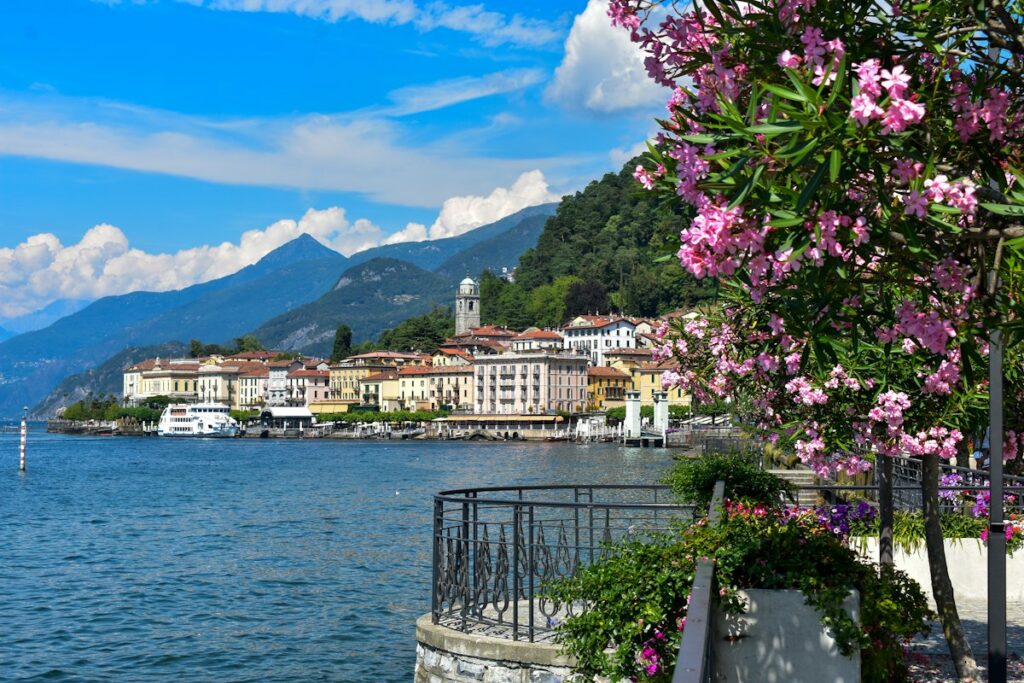
Lake Como is shaped like an upside-down Y, with the town of Bellagio at the point where the two southern branches meet. Villas, terraced gardens and steep green slopes run straight down to the water. Most visitors base themselves in Bellagio, Varenna or Menaggio and move between them by boat. It is also one of the classic day trips from Milan. For guided options, see Lake Como tours or the Lake Como boat tour.
Lake Garda
Lake Garda is the largest lake in Italy, and its shores touch three regions: Lombardy, Veneto and Trentino. The south is wide and gentle, with Sirmione on a narrow peninsula and its castle standing in the water. The north is narrow and framed by mountains, which draws sailors and windsurfers to Riva del Garda. Garda pairs naturally with Verona. Compare options in our Lake Garda tours guide, or go straight to the Lake Garda day trip with Sirmione.
Lake Maggiore and Lake Orta
Lake Maggiore stretches from Piedmont and Lombardy into Switzerland. Its highlight is the group of Borromean Islands off Stresa: Isola Bella with its palace and terraced garden, Isola Madre with its botanical garden, and the small fishing village of Isola dei Pescatori. Our Borromean Islands guide explains how to combine them, and the Lake Maggiore tour covers the lake with a guide. Just to the west, little Lake Orta has one island, Isola San Giulio, and a quiet lakeside village, Orta San Giulio.
Lake Iseo and Lake Bolsena
Lake Iseo, between Bergamo and Brescia, is smaller and less crowded than its neighbors. In the middle rises Monte Isola, a car-free island with fishing villages, and the Franciacorta wine area lies just south of the lake. Much farther south, in northern Lazio, Lake Bolsena fills an ancient volcanic basin and holds two islands, Bisentina and Martana. It is the lake to choose for a slower, less international trip in the Tuscia area.
Islands in Italy beyond the lakes: from the Bay of Naples to Sardinia
The islands fall into a few clear groups. Some, like Capri and the Venice lagoon islands, work as day trips. Others, like Sicily and Sardinia, are destinations of their own that need a week or more. In between sit small islands that reward a few nights. Compared with the lakes, the islands in Italy need more buffer time, because the sea decides when boats run.
Capri, Ischia and Procida
The three islands of the Bay of Naples share a sea but not a mood. Capri is the famous one, with the Faraglioni rocks, Anacapri on the upper slopes and the Blue Grotto, which can only be entered in calm seas. Our Capri guide covers the sights. Ischia, the largest of the three, is volcanic and green, with thermal springs and spa parks; see Ischia, the green island. Procida is the smallest, known for the pastel houses of Marina Corricella, and it was named Italian Capital of Culture for 2022. All three are among the classic day trips from Naples.
Sicily and its small islands
Sicily is the largest island in the Mediterranean, and our guide to things to do in Sicily is the place to start. Around it lie smaller archipelagos with their own character. The Aegadian Islands sit off Trapani, and Favignana, the largest, is covered in our guide to The Odyssey filming locations. To the north, the seven Aeolian Islands, including Lipari, Vulcano and Stromboli, are a UNESCO World Heritage Site for their volcanic landscapes. To the southwest, Pantelleria lies closer to Tunisia than to Sicily; see things to do in Pantelleria.
Sardinia and La Maddalena
Sardinia is the second-largest island in the Mediterranean and feels like a different country from the mainland, with its own language, food and ancient nuraghi (Bronze Age stone towers). In the northeast, the La Maddalena archipelago is a national park reached by ferry from Palau. In the northwest, Alghero keeps traces of its Catalan past, and nearby Capo Caccia hides Neptune’s Grotto. Start with things to do in Sardinia and, for the capital, things to do in Cagliari.
The Venice lagoon islands
The easiest island hopping in Italy happens inside the Venice lagoon. Murano is the island of glassmaking, Burano is known for lace and brightly painted houses, and quiet Torcello keeps the lagoon’s oldest cathedral. Public water buses link them to the city, so a half day is enough. Read what to do in Murano before you go. Among all the lakes and islands in Italy, the lagoon is the one where no car is needed at all.
The coasts: one base, several towns
On the coast, the smart move is to choose one base and travel light. Roads are narrow and parking is scarce, so trains, buses and boats usually beat a rental car. If the lakes feel too quiet and the islands too complicated, the coasts of Italy are the middle ground, with lake-like ease and island-like views.
Amalfi Coast and Sorrento
The Amalfi Coast is a UNESCO World Heritage Site: a steep strip of cliffs south of Naples with Positano, Amalfi and Ravello as its best-known towns. In the warmer months, boats are the calmest way to move along it; our Amalfi Coast ferries guide explains the routes. For a base with easier transport, many travelers choose Sorrento, just across the peninsula; see things to do in Sorrento.
Cinque Terre, Portofino and the Italian Riviera
In Liguria, the Cinque Terre are five villages on terraced cliffs: Monterosso, Vernazza, Corniglia, Manarola and Riomaggiore. A local train links them, and the coastal paths are the other classic way to connect them; see Cinque Terre hiking. Farther west, the wider Italian Riviera includes Portofino, set in a small harbor on a green promontory, and the port city of Genoa.
Puglia, Calabria and eastern Sicily
The south has longer seasons and fewer crowds. In Puglia, Polignano a Mare stands on limestone cliffs above the Adriatic, with sea caves below the old town. In Calabria, Tropea sits on a cliff on the Tyrrhenian coast, facing a sanctuary on a rock just offshore. On Sicily’s east coast, Taormina looks down on the Ionian Sea and across to Mount Etna, with the Greek theater and the islet of Isola Bella below; see things to do in Taormina. For sand rather than cliffs, our guide to Italian beaches sorts the options by region.
Lakes, islands and coasts in Italy compared
This table sums up the main lakes, islands and coasts in Italy side by side. Treat the base as a starting point, not a rule.
| Water | Best for | Base | How to get around |
|---|---|---|---|
| Lake Como | Villas, gardens, lake views | Bellagio, Varenna or Como town | Train from Milan, then boats |
| Lake Garda | Families, castles, sailing | Sirmione, Garda or Riva | Train to the south shore, then boats and buses |
| Lake Maggiore | Island gardens and palaces | Stresa | Train from Milan, then boats to the islands |
| Capri and Ischia | Iconic views, thermal spas | Naples, Sorrento or the island itself | Ferries and hydrofoils |
| Sicily | Food, ancient sites, variety | Palermo, Catania or Taormina | Car or organized tours |
| Sardinia | Beaches and wild coastline | Cagliari, Alghero or the northeast | Car and boat trips |
| Amalfi Coast | Cliffside towns, boat days | Sorrento, Amalfi or Positano | Ferries, buses and boats |
| Cinque Terre | Hiking and village hopping | Monterosso or La Spezia | Local train and trails |
Boat days on the lakes and islands in Italy
A day on the water is often the highlight of a trip to the lakes and islands in Italy, and it solves the logistics problem at the same time. The experience pages below list prices and ratings read on Viator, so you can compare before booking. For a wider selection, see our guide to the best boat tours in Italy.
- Capri boat tour with the Blue Grotto: a loop around the island by sea.
- Procida boat tour: coves and colored harbors on the smallest island in the bay.
- Amalfi Coast boat tour: the cliff towns seen from the water.
- Cinque Terre boat tour: the five villages from offshore.
- Portofino boat tour: the harbor and the promontory coast.
- La Maddalena boat tour: the archipelago off northeast Sardinia.
- Murano and Burano tour: glass and lace in the Venice lagoon.
- Polignano a Mare boat tour and Tropea boat tour: sea caves in the south.
Planning lakes and islands in Italy in one trip
Combining lakes and islands in Italy in one trip is realistic if you follow the geography. The lakes belong to the north, so they fit a route that also includes Milan, Verona and Venice, like our northern Italy itinerary. The Bay of Naples islands and the Amalfi Coast belong to the south, and they fit a route like our southern Italy itinerary.
- Travel between regions by train. High-speed trains link Milan, Rome and Naples; our guide to trains in Italy covers how they work.
- Leave slack for the sea. Rough water can cancel a hydrofoil or close a grotto, so avoid tight connections on island days.
- Think about the season. Late spring and early fall are easier on crowds on the lakes and islands in Italy, and it is worth checking boat schedules for your exact dates.
- Stay on the lungolago. The lakefront promenade is where boats, cafes and evening walks come together, so a hotel near it saves time.
Book a day on the water
Boats, islands and coast roads from the hubs above.
Selected automatically from Italy2Love experience pages that match this page, ordered by Viator rating and number of reviews (checked October 2026). Prices and availability are shown live on Viator.
Frequently asked questions
Can you visit the Italian lakes without a car?
Yes, for the main towns. Trains reach Como, Varenna, Stresa and Desenzano, and ferries link the towns on each lake. A car helps for smaller villages and the hills above the water.
Do ferries to the Italian islands run all year?
The main routes to islands such as Capri and Ischia run all year, but timetables are reduced outside summer and rough seas can cancel sailings. Check the timetable for your travel date.
When is the best time for the Italian coast?
Late spring and early fall are the best balance of warm water, open services and fewer crowds. Many beach clubs close outside the summer season.
Should you stay on an island or visit on a day trip?
A night or two on an island lets you see it before and after the day-trippers. A day trip works when time is short, but plan it around the ferry timetable.
Which of the lakes and islands in Italy are easiest to reach from Milan?
Lake Como, Lake Maggiore with the Borromean Islands, and the south shore of Lake Garda are all reachable from Milan by train, followed by a boat or a short bus ride. That makes them the simplest choice for a trip without a car.
How many days do you need for the lakes and islands in Italy?
One lake needs two to three nights to enjoy the boats and villages at an easy pace. A small island such as Procida or Favignana works in two to four nights, while Sicily or Sardinia deserve a week or more.
Which Italian lake has islands you can visit?
Lake Maggiore has the Borromean Islands, Lake Iseo has car-free Monte Isola, Lake Orta has Isola San Giulio, and Lake Bolsena has two islands, Bisentina and Martana.
Is it better to visit the Venice lagoon islands on a tour or on your own?
Murano and Burano are easy to reach on your own with the public water buses from Venice. A guided tour mainly adds glassmaking context and saves time on connections.
Build your route around the water
Pair one waterside stay with a city or countryside base instead of chasing every coast in one trip.