
BLOG · Italy2Love Magazine Guide
Chianti Wine Tours: How to Choose Between Group, E-Bike, Vespa, Private and Self-Drive (2026)
Chianti wine tours compared: group minivan, e-bike, Vespa, private driver or self-drive, plus Chianti vs. Chianti Classico, the villages, drinking limits and harvest timing.
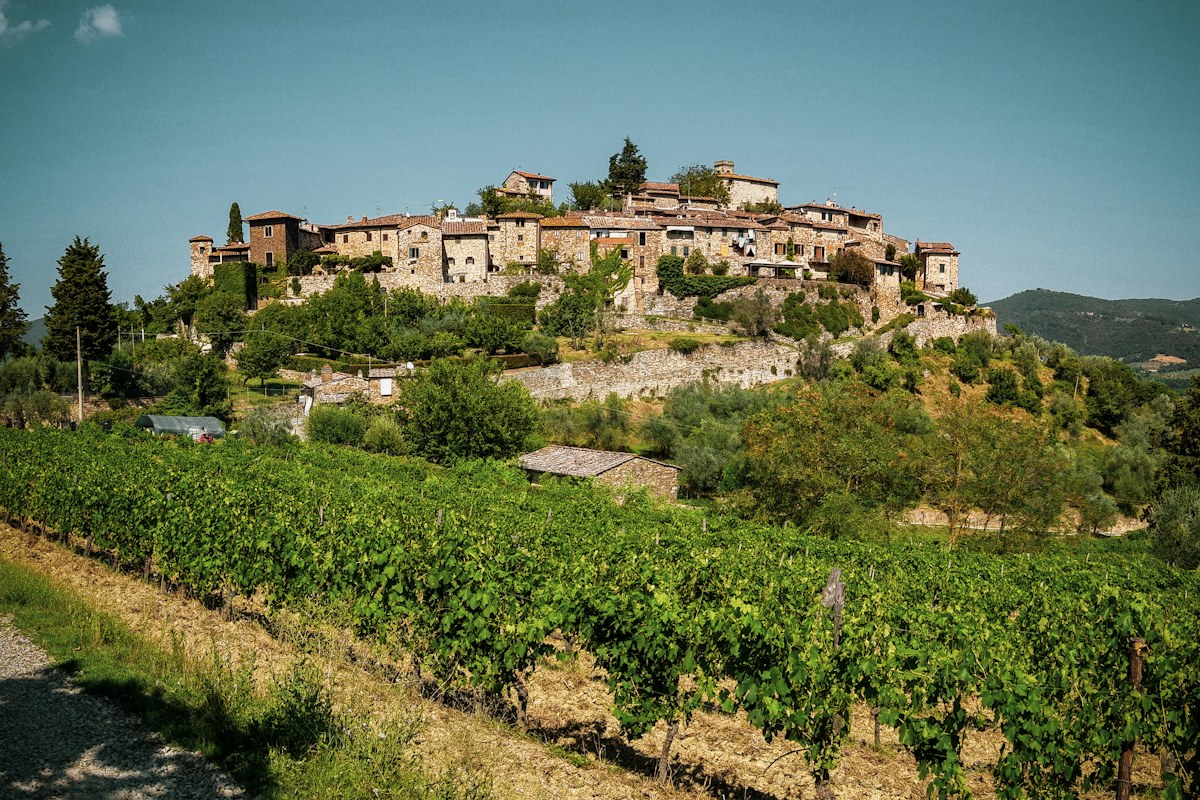
Chianti wine tours come in five main formats. The right one depends less on the wineries than on how you move between them. This guide compares group minivans, e-bikes, Vespas, private drivers and self-drive. It also explains the label you are tasting and the villages worth your time.
The short answer: for a first visit from Florence, a small-group minivan tour is the simplest choice. Nobody in your party has to drive. If you want to be active, an e-bike tour pairs tastings with countryside at bike speed. A private driver suits couples or families who want their own pace. Self-drive only works if the driver skips the wine. Italy’s legal limit is 0.5 g/l, and zero for new drivers. Finally, look for the Black Rooster on the bottle to know you are drinking Chianti Classico.
Last updated: September 26, 2026
Chianti wine tours at a glance
| Format | Best for | Who drives | What to check before booking |
|---|---|---|---|
| Small-group minivan | First-timers, solo travelers, anyone who wants zero logistics | A professional driver | Number of wineries, pickup point, whether food is included |
| E-bike | Active travelers who ride comfortably on hills and gravel | You pedal, with motor assistance | Route length, support van, how tastings fit around the ride |
| Vespa | Confident riders who want the classic scooter experience | You ride, or sit as a passenger | License rules, passenger option, how much wine the rider may drink |
| Private driver | Couples, families, serious wine lovers | A hired driver | Whether you choose the estates, hours included, vehicle size |
| Self-drive | Travelers staying in the countryside with a non-drinking driver | One of you, sober | Parking, winery reservations, the legal alcohol limit |
How to choose between Chianti wine tours
Start with one question: who is going to drive? The Chianti hills are a web of winding roads between small towns, and most estates sit outside the villages. As a result, the format decides how much you can taste and how many places you can reach.
Then think about pace. A group tour follows a fixed plan, so you trade flexibility for simplicity. By contrast, a private driver or your own car lets you linger at one estate and skip another. In addition, consider your fitness and your comfort on two wheels before choosing a bike or a scooter.
Small-group minivan tours
This is the default option from Florence, and for good reason. A driver collects the group in the city, handles the roads and brings everyone back after the tastings. For example, a Chianti wine tour from Florence lets you see the area without renting a car. The trade-off is the fixed schedule and the shared table.
E-bike tours
An electric bike flattens the climbs, so you can enjoy the vineyards at the speed they deserve. Since you keep riding after each stop, pace your tasting. Also check how long the ride lasts and whether the tour includes a support vehicle. Our page on the Chianti e-bike tour from Florence is a good place to compare.
Vespa tours
A Vespa ride through the hills is pure Italian cinema. It suits people who value the ride as much as the wine. However, the rider is driving a motor vehicle, so the same alcohol rules apply as in a car. Check the license requirements on the tour page and ask about riding as a passenger. See the Florence Vespa tour in the Tuscan hills for this format.
Private drivers
A private tour costs more than a group outing, but it gives you control. You can ask for small family estates, add lunch in a village or build a day around one grape. Above all, it removes the driving question for everyone. It is also the most flexible way to combine Chianti with a second area on another day.
Self-drive
Driving yourself works best when you stay in the countryside. For instance, you might book an agriturismo, a working farm that hosts guests. Then you can visit one or two estates per day and book tastings directly. Before you go, read our guide to driving in Italy, including limited traffic zones and parking.
Drinking and driving in Italy: the legal limit
Italy’s general blood alcohol limit for drivers is 0.5 grams per liter. The limit is zero for drivers under 21, new drivers in their first three years and professional drivers. Both figures come from the Automobile Club d’Italia (checked September 2026). Tastings add up quickly, even with small pours. In practice, the safe plan is a designated driver who does not drink at all.
The rules apply to scooters as well as cars. As a result, many visitors decide that a driver is worth the extra cost.
Chianti vs. Chianti Classico: what you are tasting
The two names sound alike but cover very different areas. Chianti DOCG is a large denomination with seven subzones, such as Rufina and Colli Senesi. It spans six provinces: Florence, Siena, Arezzo, Pisa, Pistoia and Prato. The Consorzio Vino Chianti lists both (checked September 2026).
Chianti Classico is the historic heart between Florence and Siena. It covers the whole towns of Greve, Castellina, Radda and Gaiole plus parts of four others, on about 71,800 hectares. Its producers founded their consortium in Radda on May 14, 1924, under the Black Rooster emblem, as the Chianti Classico consortium notes (checked September 2026).
Here is the practical tip. Since 2005, every bottle of Chianti Classico must carry the Black Rooster, or Gallo Nero. In other words, no rooster means no Classico. Sangiovese is the main grape in both wines. For a wider view of the region’s reds, see our guide to Tuscan wines.
Key villages to visit in Chianti
Most itineraries touch the same handful of towns along the hills. Each one gives you a reason to stop beyond the tasting room.
- Greve in Chianti: the main market town, with a broad arcaded piazza, or town square, and wine shops around it. Tours from Florence often stop here first.
- Panzano: a hilltop village in the municipality of Greve, ringed by vineyards.
- Castellina in Chianti: a walled town on the ridge toward Siena, with views over both valleys.
- Radda in Chianti: a compact medieval town and the birthplace of the Chianti Classico consortium.
- Gaiole in Chianti: the gateway to castles and estates in the southeast, including Brolio.
Also note that Montalcino, home of Brunello, lies south of Siena and outside Chianti. It deserves its own day, for example on a Montalcino Brunello wine tour.
Florence or Siena as your base
Florence offers the widest choice of Chianti wine tours, since most group and e-bike departures start there. It also puts Greve and Panzano within easy reach. Siena, meanwhile, is closer to Castellina, Radda and Gaiole, so it suits travelers who want the southern hills. Want to wake up among the vines? Compare the areas in our guide to where to stay in the Tuscan countryside.
Short on days? A Tuscany day trip to Siena, San Gimignano and Pisa covers other Tuscan highlights. Meanwhile, our list of the best day trips from Florence helps you weigh Chianti against other options.
When to go: the fall harvest in Chianti
Fall is the season most visitors picture, with gold light and grapes on the vines. In fact, the Sangiovese harvest usually begins in late September and ends in early to mid-October. In 2023, picking started around September 20 and ended in early October. That is what the consortium’s harvest page reports (checked September 2026).
The exact dates change every year with the weather. Meanwhile, small estates get very busy during picking, so book tastings ahead and ask whether visits run as usual. After the harvest, late fall is quieter and still pleasant for tastings. It is also truffle season, and a truffle hunt in Tuscany pairs well with a wine day.
Book your Chianti wine tour
Compare our reviewed experiences by format, then pick the one that matches your answer to the driving question:
- Chianti wine tour from Florence: the classic group format.
- Chianti e-bike tour from Florence: vineyards by electric bike.
- Florence Vespa tour in the Tuscan hills: the scooter option.
- Montalcino Brunello wine tour: for a second, bolder wine day.
- Truffle hunting in Tuscany: a fall add-on.
For more ideas, browse all our wine tours in Italy or start from the Tuscany travel guide.
Heading farther south? Our guide to Montalcino wine tours covers Brunello, Vino Nobile di Montepulciano and the Val d’Orcia.
For a different Sangiovese, our guide to Montepulciano wine tours explains Vino Nobile, the new Pieve tier and the historic cellars under the town.
To build Chianti into a longer trip, see our Tuscany itinerary.
If you can’t spare half a day, the Florence wine tasting page compares two tastings you can walk to in the city center.
Chianti wine tours: frequently asked questions
What is the best way to do a Chianti wine tour from Florence?
For most first-time visitors, a small-group minivan tour is the simplest option because a professional driver handles the roads. Active travelers often prefer an e-bike tour, and couples who want their own pace choose a private driver.
Can I drive myself to Chianti wineries?
Yes, but the driver should not drink. Italy’s legal limit is 0.5 g/l. It is zero for drivers under 21 and in their first three years with a license.
What is the difference between Chianti and Chianti Classico?
Chianti DOCG comes from six Tuscan provinces, while Chianti Classico comes from the historic area between Florence and Siena. Every bottle of Chianti Classico carries the Black Rooster seal.
When is the grape harvest in Chianti?
The Sangiovese harvest usually runs from late September into early or mid-October. The exact dates vary with each year’s weather.
Is Montalcino part of Chianti?
No. Montalcino lies south of Siena and makes Brunello di Montalcino, a separate wine. It deserves its own day.
Plan your day in the vineyards
Find your Chianti wine tour
Compare group, e-bike, Vespa and wine-country tours from Florence, with prices and ratings read on Viator.
Book it: experiences for this trip
Matched to this article by place and interest, then ordered by Viator rating and number of reviews (checked October 2026). Prices and availability are shown live on Viator.
Keep exploring Italy