
BLOG · Italy2Love Magazine Guide
Cicchetti in Venice: What to Order, How Bacari Work, and What It Costs
What cicchetti are, how to order at a Venice bacaro, what an ombra is, where to go, and when a guided food tour is worth it.
Last updated: September 22, 2026
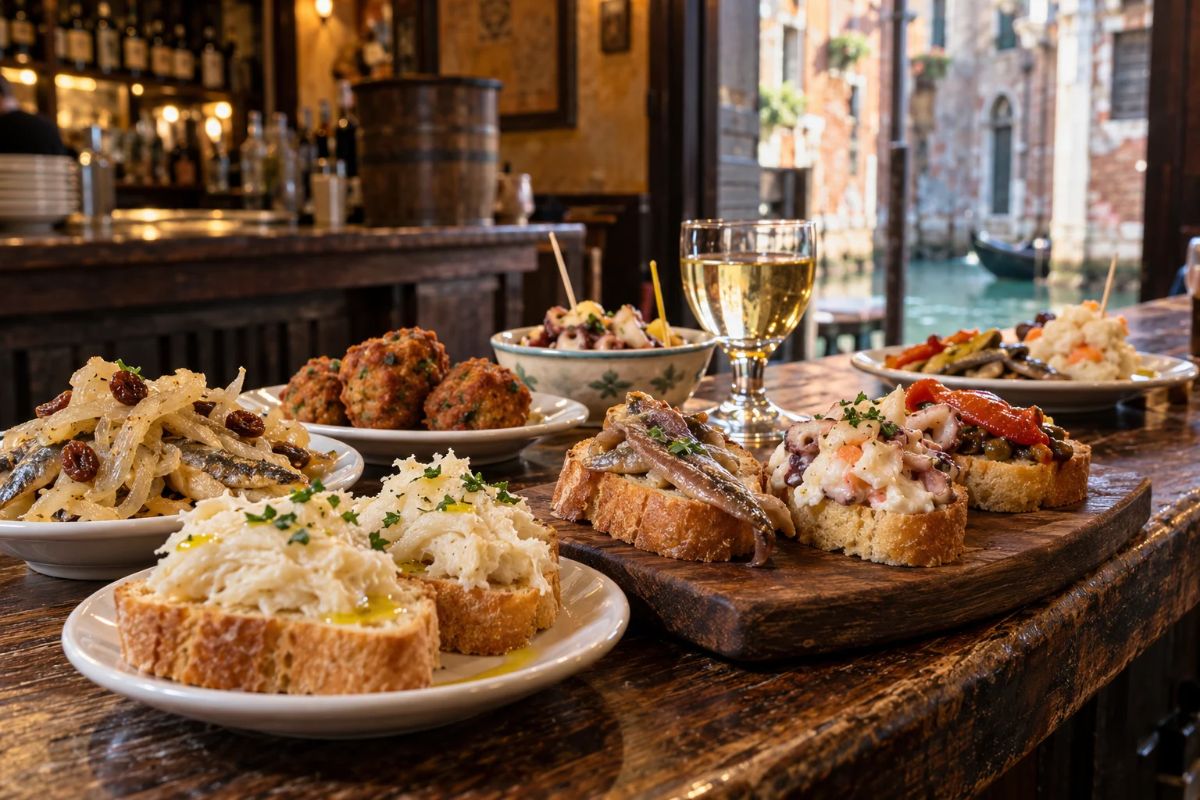
Cicchetti (chee-KET-tee) are the small bites Venetians eat standing at the counter of a bacaro, a neighborhood wine bar, usually with a small glass of wine called an ombra. You point at what you want, pay at the counter, and eat on your feet or on the street outside. The busiest bacari cluster around Rialto, Cannaregio, and Dorsoduro.
Key takeaways
- A cicchetto is a single bite-size portion, often on a slice of bread or a piece of grilled polenta. You order them one by one, not as a set meal.
- An ombra is a small glass of house wine. Ordering “un’ombra” is the Venetian way to ask for the wine that goes with cicchetti.
- Start with four classics: sarde in saor, baccalà mantecato, polpette, and tramezzini.
- Most bacari work at the counter: you order, you pay, you stand. Table service, where it exists, can cost more.
- A guided cicchetti tour on Italy2Love runs 2.5 hours and costs from about €89 (checked September 2026). Hotel pickup is not included.
- Venice’s day-tripper access fee is not being charged: the 2026 trial ended on July 26, 2026, and no 2027 calendar has been published (City of Venice, checked September 22, 2026).
What are cicchetti?
Cicchetti are Venice’s version of bar snacks: single bites made to be eaten in one or two mouthfuls with a glass of wine. The comparison with tapas helps, but the culture is its own: standing, chatting, and moving on.
A cicchetto can be a slice of bread topped with a spread, a fried ball, a skewer, a hard-boiled egg with an anchovy, or a small portion of a lagoon dish. What is on the counter changes by season and by what came in that morning. That is part of the point: you eat what looks good today.
Venetians have a phrase for the ritual of moving from one bar to the next for a glass and a bite: andar per ombre, “going for shades.” A classic evening means two or three stops, not one long sit-down.
What does the vocabulary mean? A cicchetti glossary
Learn these words and you can order at any counter in the city.
| Term | What it is | Good to know |
|---|---|---|
| Bacaro (plural bacari) | A small, informal Venetian wine bar that serves cicchetti | Often standing room only, with a counter and maybe a few stools |
| Cicchetti (singular cicchetto) | Bite-size snacks eaten with wine | Ordered one piece at a time |
| Ombra | A small glass of house wine | Local tradition links the name to the shade of St. Mark’s bell tower, where wine sellers once kept their bottles cool |
| Spritz | Wine-based aperitif: white wine or Prosecco, a bitter liqueur, and soda water | In Venice you choose the bitter; ask for “spritz” and the bartender will ask which one |
| Sarde in saor | Fried sardines marinated with onions cooked in vinegar, often with raisins and pine nuts | Sweet and sour; one of the city’s signature dishes |
| Baccalà mantecato | Dried cod whipped with olive oil into a creamy spread | In Venice “baccalà” usually means stockfish (air-dried cod), not salt cod |
| Polpette | Small fried balls of meat, fish, or tuna and potato | Ask what is inside; fillings vary by bar |
| Tramezzini | Soft, crustless triangle sandwiches | Venetian ones are generously filled in the middle |
| Folpetti | Small boiled octopus, often served warm with oil and parsley | A lagoon staple |
| Mezzo litro | Half a liter of house wine, served in a carafe | More common where you sit down, such as in an osteria (a simple, traditional eatery) |
| Aperitivo | The pre-dinner drink and snack ritual | In Venice, the aperitivo and the cicchetti crawl often blur into dinner |
How do you order cicchetti at a bacaro?
You order at the counter, point at what you want, and pay before or right after you eat. There is rarely a menu to study and nobody will seat you. Here is how it usually works:
- Find the counter. Walk up, even if it looks crowded. Venetians form a loose crowd, not a line.
- Point and count. Say or show how many pieces you want of each. “Uno di questi” (one of these) goes a long way.
- Order your drink. An ombra of white or red, a spritz, or a Prosecco. If you want something specific, ask what they pour by the glass.
- Pay. Some bacari take payment as you order; others let you pay when you leave. Watch the regulars.
- Stand. Eat at the counter, at a shelf along the wall, or outside on the fondamenta (the canal-side walkway). Bring the glass back in.
A few traps to avoid:
- Sitting down changes the deal. In places with tables, table service can cost more than eating at the bar. If you sit, check the menu before you order.
- Do not make it one long stop. Two or three cicchetti per bar, then move on. That is how the food stays fresh and how you taste more.
- Ask about allergens. Many cicchetti involve fish, shellfish, eggs, or wheat bread. Fillings are rarely labeled.
For tipping norms at counters and restaurants, see the Italy2Love guide to how tipping works in Italy.
When do Venetians eat cicchetti?
Cicchetti happen at two moments of the day: around lunchtime and in the early evening before dinner. The evening stretch, the Venetian aperitivo, is the busiest and most social.
Many bacari open in the late morning to serve market workers and locals, and some close in the afternoon before reopening in the evening. Opening hours and closing days vary by bar and by season, so there is no single timetable. The practical rule: go at lunch if you want calm counters and a full selection, and go in the early evening if you want atmosphere and do not mind crowds. The best-looking cicchetti go first, so by late evening the counter can look thin.
What do cicchetti and an ombra cost?
Italy2Love found no official or independently verifiable source for current prices of cicchetti or an ombra, so this guide does not publish a price range. Prices vary by bar, by neighborhood, and by what is on the bread.
What you can check on the spot:
- Look for posted prices. Many bacari write prices on a chalkboard or on small labels by the counter.
- Ask before you order. “Quanto costa?” (how much is it?) is a normal question.
- Compare standing and sitting. If a bar has tables, prices at the table may be higher than at the counter.
What is verified: crossing the Grand Canal on a traghetto, the shared gondola ferry, costs €2 for non-residents according to the City of Venice’s traghetto page (checked September 2026). It is often the quickest way to hop between bacari on opposite banks.
Where are the best areas for bacari in Venice?
The densest clusters of bacari are around the Rialto Market, in Cannaregio, and in Dorsoduro. Italy2Love does not name individual bars: counters change hands, and a neighborhood guide ages better than a list.
| Area | What it is like | Best for | Skip it if |
|---|---|---|---|
| Rialto (San Polo side) | Narrow lanes behind the market, the historic heart of cicchetti culture | First-timers, lunch after the market | You dislike tight crowds at peak hours |
| Cannaregio | Canal-side walkways with outdoor standing space, more residential | Early-evening aperitivo, a longer crawl | You want to stay near St. Mark’s |
| Dorsoduro | Student energy around Campo Santa Margherita, quieter canals near the Accademia | Evenings, pairing with museum visits | You want a very quiet, late-night scene |
Rialto is compact, so a crawl of three stops takes little walking. In Cannaregio, the northern canals offer something rare in Venice: room to stand outside with a glass. In Dorsoduro, Campo Santa Margherita, a large campo (square) popular with students, stays lively into the evening.
For a wider view of the city, start from the Italy2Love Venice destination guide and the list of Venice’s top attractions.
Food tour or on your own?
Go on your own if you are comfortable pointing, paying, and moving on without knowing the names of dishes. Book a guided tour if it is your first evening in Venice, you want the dishes explained, or you would rather not spend time finding the right lanes.
How we picked
Italy2Love lists one cicchetti tour. The criteria: it is dedicated to cicchetti and wine rather than general sightseeing, it holds a high rating across more than 2,000 reviews, and at 2.5 hours it fits before dinner without taking a full day.
The guided option: Venice Cicchetti Food and Wine Tour
The Venice cicchetti and wine tour Italy2Love reviewed is rated 4.8/5 on 2,178 reviews, lasts about 2.5 hours, and costs from about €89 (checked September 2026). The route includes a crossing of the Grand Canal by traghetto.
What to know before booking:
- Hotel pickup is not included. You make your own way to the meeting point, which in Venice means walking or a vaporetto (the public water bus). Allow extra time: addresses are hard to find.
- Access fee notes may be outdated. Some tour listings still mention the Venice access fee. According to the official access fee site of the City of Venice, the fee has not applied since July 27, 2026 (checked September 22, 2026).
- Who should skip it: travelers on a tight budget, those who prefer to linger at a table, and anyone with dietary restrictions who has not confirmed with the operator what can be adapted.
On your own versus a guided tour
| On your own | Guided cicchetti tour | |
|---|---|---|
| Cost | You pay only for what you eat and drink | From about €89 per person (checked September 2026) |
| Time | As long or short as you like | About 2.5 hours |
| Dish explanations | Ask at the counter; depends on the bartender | Included in the experience |
| Getting around | You find the bacari and the traghetto stops | Route planned, traghetto crossing included |
| Flexibility | Total | Fixed start time and route |
| Best for | Repeat visitors, confident eaters | First night in Venice, curious food lovers |
| Skip it if | You feel lost without a menu | You want to set your own pace or budget |
For other food experiences across Italy, browse the Italy2Love food tours hub.
Cicchetti for lunch on a full-day Venice tour
If you are booking a full-day tour, plan the lunch yourself. The St. Mark’s, Doge’s Palace, Murano and Burano day tour (4.6/5 on 1,062 reviews, about 9.5 hours, from about €185.35, checked September 2026) does not include lunch. A few cicchetti at a counter are faster than a sit-down meal and fit the gaps of a long day.
Two practical notes: the name on the ticket must match the name on your ID to enter St. Mark’s Basilica, and about 2.5 hours of the day go to boats and transfers. Skip it if you dislike long, structured days. For free time on the islands, see what to do in Murano.
Do you need to pay the Venice access fee to go for cicchetti?
No, not at this time. According to the City of Venice, the 2026 trial applied on 60 selected days between April 3 and July 26, 2026. Since July 27, 2026, visitors can enter without paying or requesting an exemption. No 2027 calendar has been published; the decision rests with the city government (checked September 22, 2026).
Cicchetti are Venice’s version of a wider ritual. Our guide to aperitivo in Italy explains the drinks, regional styles and etiquette.
If this is your first visit, pair the bar crawl with our guide to the best tours in Venice, which plans three days around the sights worth booking ahead.
Nervous about the language? Start with these useful Italian phrases for travelers, each with simple pronunciation.
Where to stay
Planning to spend the night in Venice? Book a central base and you will lose less time in transit, especially if you start early. Not sure which area to pick? Our guide to where to stay in Venice compares the best areas.
Affiliate links: if you book through them, Italy2Love earns a commission at no extra cost to you.
Compare places to stay in Venice →Frequently asked questions
What are cicchetti in Venice?
Cicchetti are small bites served in Venetian wine bars called bacari. They range from slices of bread topped with baccalà mantecato to fried polpette, sarde in saor, and small tramezzini. Venetians eat them standing at the counter with a small glass of wine, usually at lunchtime or in the early evening, and often move between two or three bars in one outing.
What is an ombra in Venice?
An ombra is a small glass of house wine, the traditional drink with cicchetti. The word means “shade” in Italian. Local tradition links it to wine sellers who kept their bottles in the shade of St. Mark’s bell tower. To order one, ask for “un’ombra” and say whether you want white or red.
How do you order cicchetti?
Walk up to the counter, point at the pieces you want, and say how many. Order your drink at the same time. Depending on the bar, you pay as you order or when you leave. Most people eat standing at the counter or outside. If you sit at a table, check the menu first, because table service can cost more.
How much do cicchetti cost in Venice?
Italy2Love found no official source for current cicchetti prices, so this guide does not quote a range. Prices vary by bar, neighborhood, and topping. Many bacari post prices on a chalkboard or on labels by the counter, and asking “quanto costa?” before ordering is normal. Eating at the counter can cost less than sitting at a table.
Where are the best areas for cicchetti in Venice?
The main areas are the lanes around the Rialto Market, the canal-side walkways of Cannaregio, and Dorsoduro around Campo Santa Margherita. Rialto is the most traditional and the busiest. Cannaregio offers outdoor standing space and a more local crowd. Dorsoduro is lively in the evening and pairs well with a museum afternoon near the Accademia.
Is a Venice food tour worth it for cicchetti?
A guided tour is worth it on a first visit if you want the dishes explained and a planned route. The tour listed on Italy2Love lasts about 2.5 hours, costs from about €89 (checked September 2026), and includes a traghetto crossing, but not hotel pickup. Confident travelers who enjoy exploring can do the same crawl on their own for less.
Do I need to pay the Venice access fee in fall 2026?
No. According to the City of Venice, the 2026 access fee trial ended on July 26, 2026, and since July 27, 2026 visitors can enter without paying or requesting an exemption. The city has not published a 2027 calendar yet. Check the official access fee site of the City of Venice before any trip in 2027.
What is the difference between a spritz and an ombra?
An ombra is a small glass of plain house wine, white or red. A spritz is a mixed aperitif made with white wine or Prosecco, a bitter liqueur, and soda water. In Venice the bartender will usually ask which bitter you want. Both go with cicchetti; the ombra is the more traditional pairing.
Tours we’ve reviewed
- Venice Cicchetti Food and Wine Tour: 2.5 hours, no hotel pickup.
- Venice: St. Mark’s, Doge’s Palace, Murano and Burano: about 9.5 hours, lunch not included.
Sources and verification
- City of Venice, official access fee site (Contributo di Accesso): end of the 2026 trial and no fee since July 27, 2026, checked September 22, 2026.
- City of Venice, access fee information page: 2026 calendar of 60 days from April 3 to July 26, 2026; no 2027 calendar published, checked September 22, 2026.
- City of Venice, traghetto da parada fares and stations page: €2 fare for non-residents, checked September 22, 2026.
- Tour details, ratings, and prices: Viator product pages as listed on Italy2Love, checked September 2026.
Staying longer? Our guide to the best day trips from Venice covers the islands, Padua and the Dolomites.
Book it: experiences for this trip
Matched to this article by place and interest, then ordered by Viator rating and number of reviews (checked September 2026). Prices and availability are shown live on Viator.
Keep exploring Italy