
ART & HISTORY · Italy2Love Magazine Guide
Parma itinerary: two days of art and food without a car
This Parma itinerary brings together two days of art, local food and riverside walks, with practical advice on museum closures, arriving by train and choosing where to stay.
Above Parma Cathedral, Correggio’s painted figures spiral into a sky that seems to open through the dome. Outside, the next stop is a short walk away. This Parma itinerary gives you two days to enjoy that closeness: churches and theatres, a substantial museum visit, fresh pasta and a neighbourhood across the river, all without hiring a car.
Parma rewards travellers who want to look carefully rather than collect stops. You can spend a morning with medieval sculpture, take a proper lunch break, and still have room for a theatre visit. Staying overnight also lets you experience the city after the sightseeing circuit has finished, when choosing somewhere for dinner becomes the evening’s main decision.
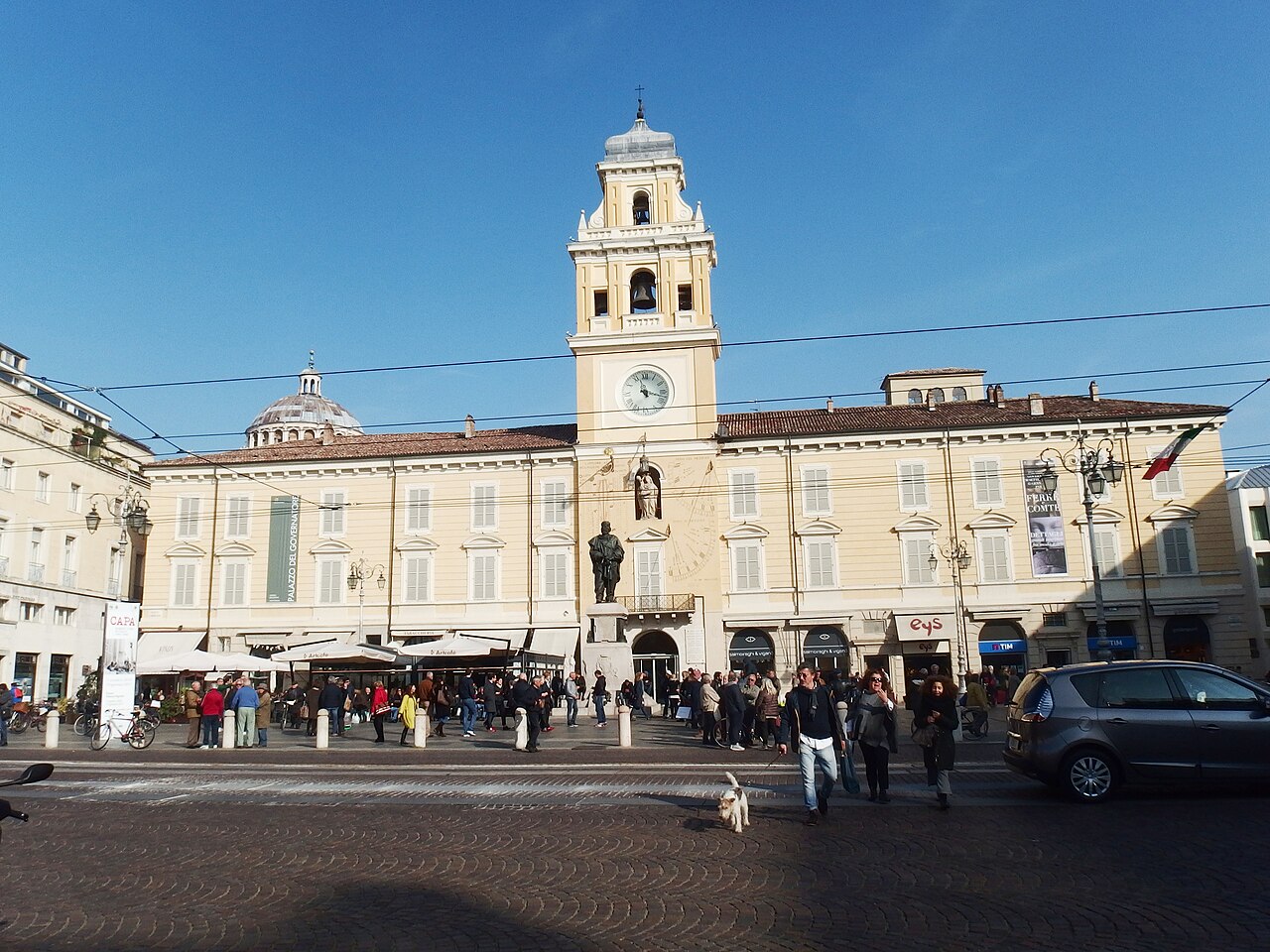
Featured photograph: Piazza Garibaldi and Palazzo del Governatore, by Palickap / Wikimedia Commons, CC BY-SA 4.0. Resized.
Your Parma itinerary at a glance
Parma is in Emilia-Romagna, in northern Italy, on the railway corridor between Milan and Bologna. The Parma stream divides the historic city. Most first-visit monuments lie on the eastern side; Oltretorrente, literally “beyond the torrent”, is the neighbourhood across it. The railway station sits north of the centre, so arriving by train does not leave you dependent on a rural transfer.
The route uses the cathedral district and Teatro Regio on the first day, then the Pilotta, Parco Ducale and Oltretorrente on the second. These are compact groups, not a reason to book every hour. The visit allowances below are planning suggestions, while walking allowances assume a steady pace without luggage. Neither includes queues, lunch or time spent stopping for photographs.
| When | Main plan | Allow for the visit | Walking between areas |
|---|---|---|---|
| Day 1, morning | Cathedral, Baptistery and Diocesan Museum | About 2–2½ hours together | These sights share the cathedral square |
| Day 1, afternoon | Central streets, Steccata and a booked Teatro Regio tour | About 2 hours, plus your tour waiting time | Roughly 5–10 minutes between central stops |
| Day 2, morning | Pilotta, including Teatro Farnese | At least 2½–3 hours | About 10 minutes from the cathedral district |
| Day 2, afternoon | Parco Ducale and Oltretorrente; optional Toscanini museum | 2–3 hours with breaks | Allow 15–20 minutes across the wider park and neighbourhood route |
If your train arrives at lunchtime, this becomes two nights with a partial third day rather than a compressed overnight stop. Do the cathedral district on arrival afternoon, reserve the following morning for the Pilotta, and keep the theatre or Oltretorrente for departure day. Confirm luggage storage with your accommodation before relying on it.
Day one: the cathedral square, painted ceilings and opera
Start with Piazza Duomo
Begin in Piazza Duomo while you still have the attention for details. The cathedral’s Romanesque façade gives little warning of the movement inside its dome. Correggio’s Assumption draws the eye upwards through bodies, clouds and light; give yourself time to change position rather than trying to understand it from the entrance. Down at human scale, Benedetto Antelami’s Deposition relief offers a completely different encounter with religious storytelling.
The cathedral complex’s official visitor information lists individual cathedral admission as free. The Baptistery and Diocesan Museum use a combined ticket, currently €12 for a standard adult, valid for two days. They are separate visits, so retain your ticket rather than treating the square as one building with one entrance.
Allow a pause between interiors. The square itself helps make sense of the relationship between the monuments, and the Baptistery deserves attention from outside before you enter. Church access can change around worship: dress respectfully, keep voices low and let a service determine the pace. If an area is unavailable, move lunch or the museum forward instead of waiting for the whole morning to unravel.
Leave space for San Giovanni and the central streets
San Giovanni Evangelista stands behind the cathedral and adds another chapter to Parma’s painted interiors. The monastery church is associated with both Correggio and Parmigianino. Treat it as a worthwhile extension when visitor access allows, rather than making your timetable depend on entry to every part of the monastic complex.
From here, walk back towards Strada Cavour and Piazza Garibaldi. The change from the cathedral square to shops, café tables and everyday errands is part of the appeal. You are now moving through a working city centre. Look at shop windows, choose a place for lunch, and resist turning every side street into another compulsory attraction.
One important omission is deliberate: the Camera di San Paolo is closed for conservation work, with reopening indicated provisionally for spring 2027. Do not build a winter visit around seeing its frescoes. Check the reopening notice before a later trip, then add it only if access has actually resumed.
Visit Teatro Regio, then look inside the Steccata
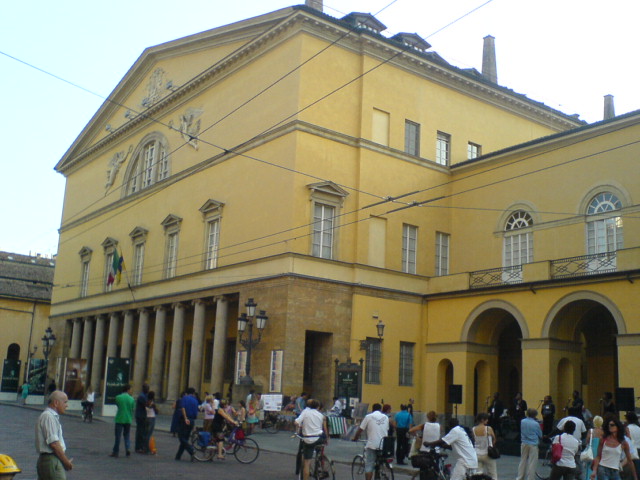
Book a Teatro Regio visit for the afternoon if the theatre’s calendar allows. Its guided route gives you a sense of the building as a place for performance, not simply a decorated room. The normal tour lasts around 30 minutes and is offered in Italian and English; the standard adult ticket is currently €12. Rehearsals and performances can restrict the route or prevent visits, so use the theatre’s own booking information before fixing lunch around a particular time.
Nearby, Santa Maria della Steccata offers a quieter architectural counterpoint: a Renaissance church with a Greek-cross plan and decoration associated with Parmigianino. A short visit can work well here, provided the church is open to visitors. You do not need to turn the afternoon into a comparison of every painted ceiling; choose one detail you want to remember.
If opera is a main reason for travelling, reverse the order of planning: secure the performance you want, then arrange your stay. A daytime tour does not include an evening performance. Equally, Teatro Regio and the Teatro Farnese inside the Pilotta are different theatres with different admission arrangements. Seeing one does not replace the other.
Day two: the Pilotta, a park and Oltretorrente
Give the Pilotta a full morning
The Pilotta is the visit most likely to expand beyond your initial estimate. Its collections and spaces bring together painting, archaeology, books and theatre within a large palace complex. Start with a realistic minimum of two and a half to three hours, then choose what matters most to you from the route open that day. Keen museum visitors can easily prefer a longer morning and a shorter afternoon walk.
Teatro Farnese supplies the most immediate change of scale. Its architecture uses painted wood to evoke richer materials, creating a theatrical world before any performance begins. First used in 1628 for a ducal wedding, the theatre was heavily damaged during the Second World War and subsequently reconstructed. The room you see carries both its courtly origins and the history of rebuilding.
The Pilotta’s current opening information lists Tuesday to Sunday, with Monday closure. Some sections have their own opening times, so a start around 10:30 is a useful planning choice if you want access beyond the earliest-open rooms. Check temporary closures and the available route before buying. The standard adult museum ticket is currently €18; it does not cover the cathedral district or Teatro Regio.
Leave lunch unbooked until you know how ambitious your museum morning will be, or choose a reservation with enough margin. What makes this itinerary manageable is not unusually fast sightseeing: it is the decision to give the Pilotta priority and keep the afternoon flexible.
Cross to Parco Ducale
After the galleries, cross towards Parco Ducale for a change of light and pace. Its broad avenues and trees make this a useful place to stop looking at buildings for a while. Entry to the park is free. Allow half an hour for a simple walk or longer if you want to sit, read or take a coffee break elsewhere before continuing.

In winter, use the available daylight for this section and shorten it in rain. The park is a breathing space in the plan, not an obligation to spend an hour outside regardless of weather. If you have limited walking stamina, a shorter circuit followed by a café stop is more useful than trying to cover every avenue.
Finish across the river
Continue into Oltretorrente, where the route becomes less about a single monument and more about the streets around you. This is a good place to slow down after the Pilotta, looking for a meal or a small museum rather than another major ticket. Cross back towards the centre when you feel ready, instead of setting an arbitrary target for how much ground you must cover.

For a specific destination, the Arturo Toscanini birthplace museum in Borgo Rodolfo Tanzi connects the neighbourhood with Parma’s musical history. Its letters, photographs and personal objects offer a more intimate visit than the morning’s palace. Allow roughly 45–60 minutes if the opening schedule fits. Check its own admission arrangements: this is not another room included in the Pilotta ticket.
What to eat, and when to add a producer visit
For a first lunch, tortelli d’erbetta are a useful starting point: filled pasta with ricotta and greens, finished with butter and Parmigiano Reggiano. They show how satisfying a dish can be without a long list of ingredients. Anolini in broth offer another traditional direction, while torta fritta and cured meats suit a shared table. Read the menu carefully if you avoid meat; a dish’s name alone may not explain its filling, broth or cooking fat.
Give one meal enough time to become part of the day. An early museum start followed by a seated lunch works better here than buying snacks to protect an overfilled schedule. For dinner, reserve if you have a particular restaurant in mind, especially at the weekend, and check its kitchen hours. A bar that remains open through the afternoon is not necessarily serving its full lunch menu.
Parma also makes a good place to learn the difference between foods you recognise by name. Our guide to Italian cheeses gives useful context before shopping. Ask a food shop about portion size, packaging and storage, and check your destination country’s import rules before buying animal products to take home.
A dairy or ham producer visit is a different logistical choice from eating in the city. Producers may be outside Parma, and seeing cheese production can require a morning departure. Do not assume that a factory shown on a Parma tour listing is within walking distance of your hotel. Check the meeting point, transport included, duration and return arrangements before committing.
If production is central to your trip, add a third morning and compare the options in our Parma food tours guide. The Parmigiano and prosciutto experience page provides another starting point for assessing a guided outing. Keep that excursion separate from the two-day city route; replacing the Pilotta with a producer tour changes the character of the visit.
Arriving by train and getting around without a car
Train travel suits this plan particularly well. Regional services connect Parma and Bologna in roughly an hour to an hour and a quarter, depending on the train. Treat that as time on board, not a door-to-door promise: add the journey to your departure station, waiting time and the walk to your accommodation. Check the timetable for your actual dates, including any engineering changes.
From Parma station, the Pilotta’s official directions describe a walk of about ten minutes. Other central destinations take longer, and luggage will slow you down. Download your hotel’s exact location before arrival; “near the station” can describe different sides of a substantial building and road layout.
If flying into Bologna, use our Bologna airport transport guide to plan the first connection before looking at the onward train. For a longer rail trip, pair this stay with our Bologna itinerary. Give each city its own time instead of repeatedly commuting back to the same hotel merely because the train journey looks short.
Walking covers the sights in this guide, but compact does not mean universally step-free. Historic paving, thresholds and museum routes can matter more than distance. Travellers with mobility requirements should confirm the precise entrance and assistance arrangements with each venue, and room access with the hotel. A centrally located room is not automatically an accessible room.
If Parma is part of a road trip, arrange parking before reaching the historic centre. A ZTL is a limited-traffic zone, often monitored by cameras. A hotel reservation does not by itself give permission to enter: ask the property which approach is permitted and whether it needs to register your number plate. The city’s arrival-by-car guidance is the place to check current access arrangements. Once parked, leave the car out of this city itinerary.
Where to stay for two days in Parma
Choose your base around how you want the mornings and evenings to work. For this trip, location is more consequential than a long amenities list: a room near dinner and the main sights makes it easier to rest between visits. A station-side hotel solves a different problem, giving you a simpler arrival or departure with bags.
| Base | Best reason to choose it | What to check |
|---|---|---|
| Historic centre, around Garibaldi or the cathedral district | Short walks to sightseeing and dinner | Street noise, stairs or lift, and vehicle access if arriving by taxi or car |
| Railway station area | Convenient train arrivals and early departures | The exact station exit and walking route to your hotel |
| Oltretorrente | A base near the park and the neighbourhood used on day two | The address relative to a bridge, plus the walk back after dinner |
NH Parma: a practical option beside the station
NH Parma, at Viale Paolo Borsellino 31, is worth considering if rail convenience leads your decision. The hotel is part of the station complex rather than a property overlooking a historic square. That is the trade-off: straightforward access to trains, with a walk into the older centre for the atmosphere and sights described here.
The hotel’s official information lists air conditioning, Wi-Fi, a gym, a restaurant and a bar. Its Expedia listing includes a Standard Room for two, with a double or twin-bed configuration. Check the bed arrangement offered for your dates rather than assuming a preference is guaranteed. Breakfast and parking appear as available services; inspect the selected rate to see what is included.
Choose it for a train-based stay with practical facilities, not because you expect to open the door directly onto Piazza Duomo. If you value returning to your room between several short central visits, compare a historic-centre address first. Availability, cancellation terms and room categories vary by date; the presence of a listing does not establish that a particular room is available for your trip.
For a wider regional journey, our Emilia-Romagna accommodation guide helps put Parma alongside other possible bases. Keep the comparison focused: total stay cost, location, cancellation terms and the facilities you will actually use. There is little value in choosing an outlying hotel for a facility you will not have time to enjoy.
When to go, what to budget and how to adapt the plan
April, May, September and October are sensible first choices for balancing indoor visits with walks and the park. They are recommendations, not guarantees of mild weather. Carry a layer and something for rain, and leave the longest outdoor stretch movable. Spring suits a longer park stop; autumn works particularly well if you want museums and substantial meals to share the day.
Winter makes sense for travellers who are happy to put art first. Plan outdoor walking in daylight, keep the park optional and choose accommodation that makes evening returns easy. A wet afternoon can become a longer museum visit or a booked theatre tour if available. Summer is still possible, but heat can change the appeal of long walks; start earlier and protect a proper midday break.
For the three paid visits highlighted here, current standard adult tickets add up to €42: €12 for Baptistery and Diocesan Museum, €18 for the Pilotta and €12 for the Regio guided tour. This is a planning subtotal, not a city pass or a complete trip budget. It excludes accommodation, meals, transport, Toscanini museum admission, performances and any booking charges. Concessions and special openings may change what you pay.
Sunday–Monday stays need a different order. Put the Pilotta on Sunday and use Monday for the streets, park and churches when visitor access permits. Confirm theatre and smaller-museum opening independently. If your priority is two full museum days, choose dates that avoid making Monday the central day of the trip.
The most useful final decision is whether you want a city break or a city-and-countryside food trip. Two days are enough for the former at a satisfying pace; the latter deserves more time and a transport plan. Set your Parma itinerary around an open Pilotta day, choose a central or station-side base, and reserve the visits that matter most before filling the remaining hours.
Book it: experiences for this trip
Matched to this article by place and interest, then ordered by Viator rating and number of reviews (checked September 2026). Prices and availability are shown live on Viator.
Keep exploring Italy
Where to stay
Planning to spend the night in Parma? Book a central base and you will lose less time in transit, especially if you start early.
Affiliate links: if you book through them, Italy2Love earns a commission at no extra cost to you.
Compare places to stay in Parma →